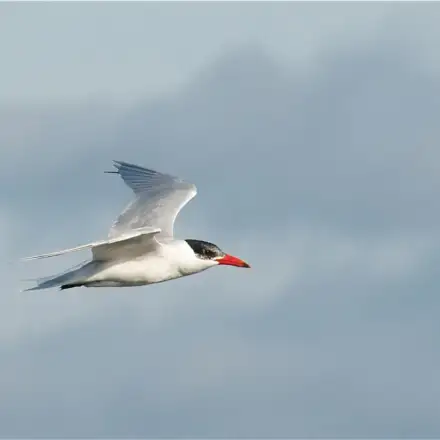
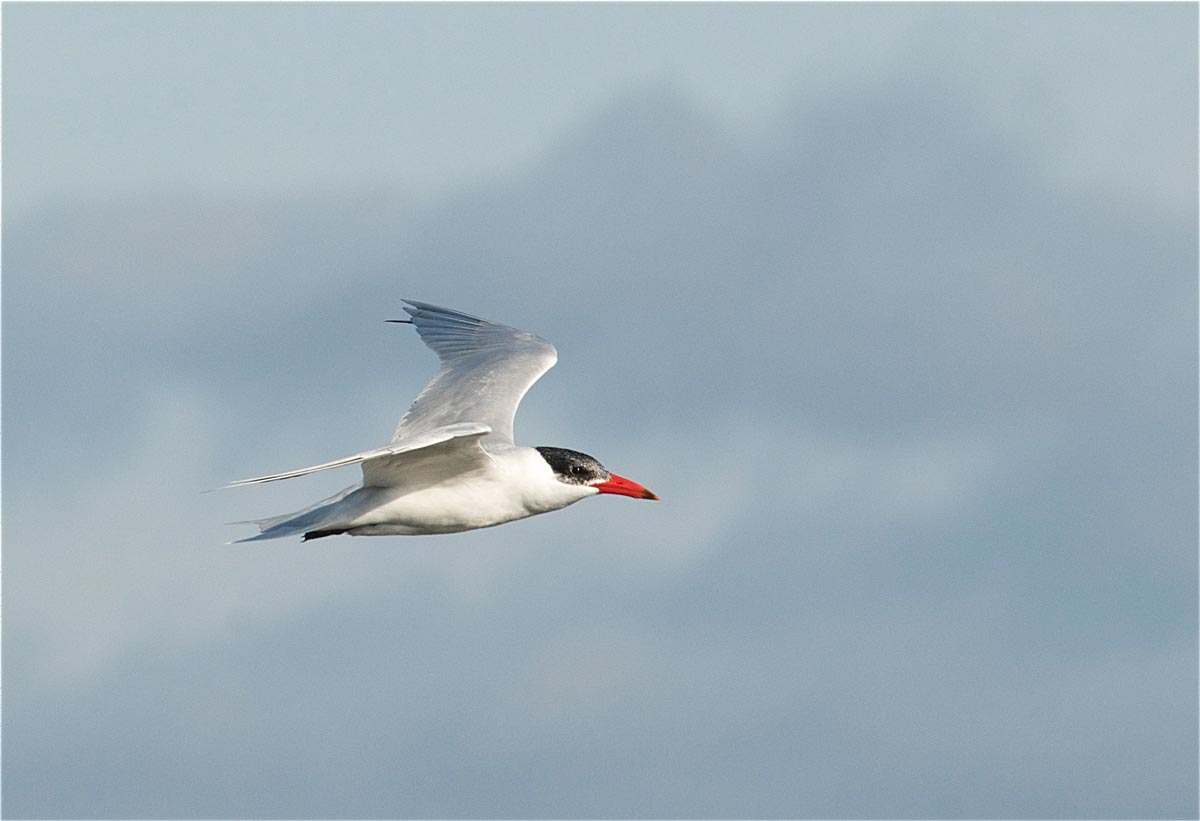
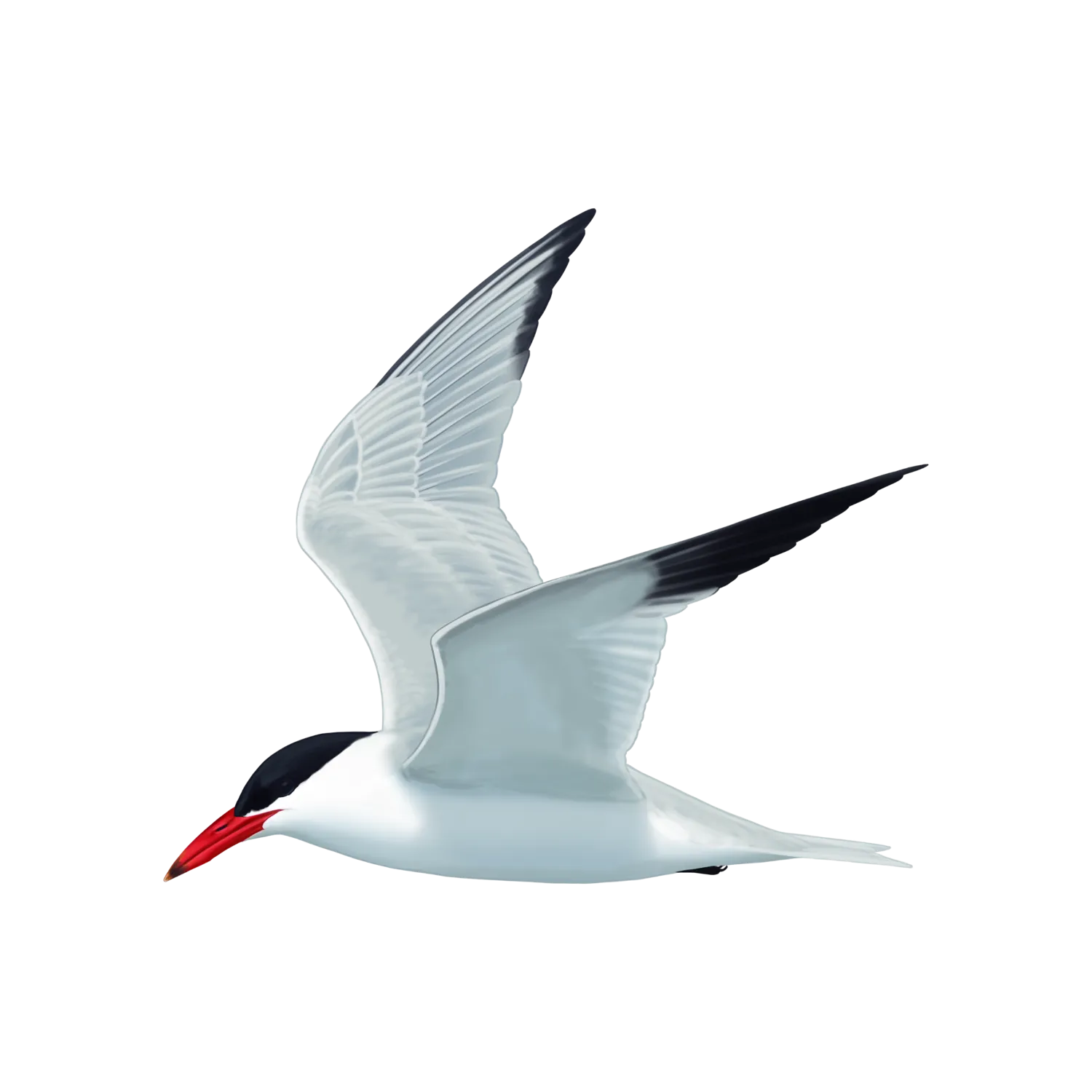
Caspian Tern
Scientific name: Hydroprogne caspia
Family laridae
Phenology
- Mainland
- Wintering and passage migrant
- Madeira
- Vagrant
- Azores
- Vagrant
Conservation status
Learn more- Mainland
- Madeira
- Azores
- IUCN Global
Data
Maps
Distribution | Non-breeding
Scale
Minimum value:
Maximum value:
Scale
Minimum value:
Maximum value:
Scale
Minimum value:
Maximum value:
Scale
Minimum value:>
Maximum value:<
Scale
Minimum value:
Maximum value:
Scale
Minimum value:>
Maximum value:>
Distribution based on seabird tracking data (locations/hexagone).
Colony(ies) of origin:
Device:
Data period / number of individuals:
Data period / number of individuals:
Distribution of seabird breeding colonies or sites (number of breeding pairs).
Distribution based on marine censuses (probability of occurrence).
Observed density based on marine censuses (birds/ km2).
Confirmed occurence during marines censuses.
Abundance of waders derived from Project Arenaria coastal surveys (birds/square).
Passage rates derived from RAM coastal surveys (birds/hour).
No data available for the selected period.
Presentation
Distribution, movements and phenology
The Caspian Tern has a wide distribution, breeding between April and June on large lakes and coastal areas of North America and, locally, in Europe, Asia, Africa and Australasia (Billerman et al. 2026). Populations in the northern hemisphere are migratory, wintering in tropical regions, whilst those in Africa and Australasia are mostly resident or undertake short-distance dispersals. In Mainland Portugal, it occurs as a winter visitor and a rare passage migrant, being more common between August and March in the Algarve, in estuaries, wetlands and salt pans (Catry et al. 2010a). The birds occurring in this region originate mainly from colonies in the Baltic Sea and winter primarily in West Africa (Rueda‐Uribe et al. 2022). Based on data from four birds fitted with GPS in 2018 and 2019, originating from colonies in Sweden and Finland, the use of the Portuguese EEZ in the southern part of the Mainland sub-area was observed during both migratory periods, but with a more prolonged occurrence during the post-breeding period. These data do not show use of the Azores and Madeira sub-areas, although there have been some, albeit few, observations of the species in both regions (Correia-Fagundes et al. 2021; Birding Azores 2022).
Abundance and population trends
The global population has been estimated at between 250,000 and 470,000 individuals, with approximately 11,800 to 14,800 breeding pairs in Europe (BirdLife International 2025). The global population trend is increasing, although some populations are in decline, as is the case with the Baltic Sea populations (Rueda‐Uribe et al. 2022). Others show some stability or even unknown trends (BirdLife International 2025).
In Mainland Portugal, it is most abundant during migratory passages, with a small wintering population. However, there are no estimates of its abundance or population trends, which has made it impossible to assess its environmental status. The same situation applies to the Azores and Madeira.
Ecology and habitat
The Caspian Tern nests on sandy or stony beaches, dunes, flat rocky surfaces, sheltered reefs or islands with sparse vegetation and shallow, undisturbed waters (Billerman et al. 2026). The species feeds mainly on fish, supplementing its diet with other animal resources, including bird chicks, carrion and invertebrates (Shuford & Craig 2002). In winter, it is mainly concentrated along the coast, using sheltered shores and coastal wetlands, but may also occur in inland wetlands.
Threats and conservation
The main threats to the species include habitat and nesting site loss and climate change, as the coastal and freshwater ecosystems on which they depend have been degraded by human activities, including pollution, acidification, rising water temperatures and hydrological changes (Rueda‐Uribe et al. 2022). It is also particularly vulnerable to human disturbance, as well as to reduced fish availability due to overfishing (Shuford & Craig 2002). In Portugal, no direct threats have been identified, but it is essential to maintain the protection of wetlands and the monitoring of resting and feeding areas (Catry et al. 2010a).
- Autor
Inês Lacerda
- Owners/sources of tracking data
Shuford WD & Craig DP (2002). Status assessment and conservation recommendations for the Caspian Tern (Sterna caspia) in North America. U.S. Department of the Interior, Fish and Wildlife Service, Portland, OR. Bibliography:
Rueda‐Uribe C, Lötberg U, Ericsson M, Tesson SV & Åkesson S (2021). First tracking of declining Caspian terns Hydroprogne caspia breeding in the Baltic Sea reveals high migratory dispersion and disjunct annual ranges as obstacles to effective conservation. Journal of Avian Biology 52. Bibliography:
Correia-Fagundes C, Romano H, Zino FJA & Biscoito M (2021). Birds of the archipelagos of Madeira and the Selvagens III. New records and checklist update (2010-2020). Boletim do Museu de História Natural do Funchal LXXI: 5-20. Bibliography:
BirdLife International (2025). IUCN Red List for birds. Downloaded from https://datazone.birdlife.org on 30.11.2025. Bibliography:
Birding Azores (2022). Birding Azores database. Downloaded from https://www.azoreswildlife.com/ on 23.12.2025. Bibliography:
Billerman SM, Keeney BL, Kirwan GM, Medrano F, Sly ND & Smith MG (eds.) (2026). Birds of the World. Cornell Laboratory of Ornithology, Ithaca, NY, USA. Bibliography:
Catry P, Costa H, Elias G & Matias R (2010a). Aves de Portugal, Ornitologia do Território Continental. Assírio e Alvim, Lisboa Data:
Åkesson S, Lötberg U & Rueda-Uribe C (2022). Data from: Study "Tracking of Caspian Terns (Hydroprogne caspia) in the Swedish Baltic Sea 2017-2020". Movebank Data Repository. Data:
Byholm P, Beal M, Lötberg U & Åkesson S (2022). Data from: Paternal transmission of migration knowledge in a long-distance bird migrant. Movebank Data Repository. Downloaded from https://www.doi.org/10.5441/001/1.352qf1cv. Glossary:
Persistent changes in global or regional climate patterns, influenced by natural and anthropogenic factors. Glossary:
The direction of change in the size of a population over time (increase, decline or stability). Glossary:
A concept defined under the Marine Strategy Framework Directive (MSFD), referring to the condition of the elements of the marine environment, including birds. It aims to assess whether ecosystems are healthy, balanced and capable of supporting ecological functions and human uses in a sustainable manner. The ultimate goal is for the components and ecosystems to achieve Good Environmental Status. Glossary:
A small device attached to birds to study their movements at a finer scale (usually during the breeding season). These devices use the Global Positioning System (GPS) to obtain information on position, latitude, longitude and altitude at any point on Earth, using a network of orbiting satellites. Glossary:
Under the United Nations Convention on the Law of the Sea, coastal states are entitled to declare an EEZ comprising maritime area beyond their territorial waters. The national EEZ is delimited by an imaginary line situated 200 nautical miles from the coast, separating national waters from international or shared waters. Within its EEZ, each state has rights such as the exploitation of marine resources, the conduct of scientific research and the regulation of fishing by foreign vessels. Glossary:
A form of fishing in which fish stocks (or populations) are exploited to levels that are biologically and ecologically unsustainable. Overfishing of certain key species, such as sharks, can lead to the collapse of marine ecosystems. Glossary:
Referring to the period following breeding.