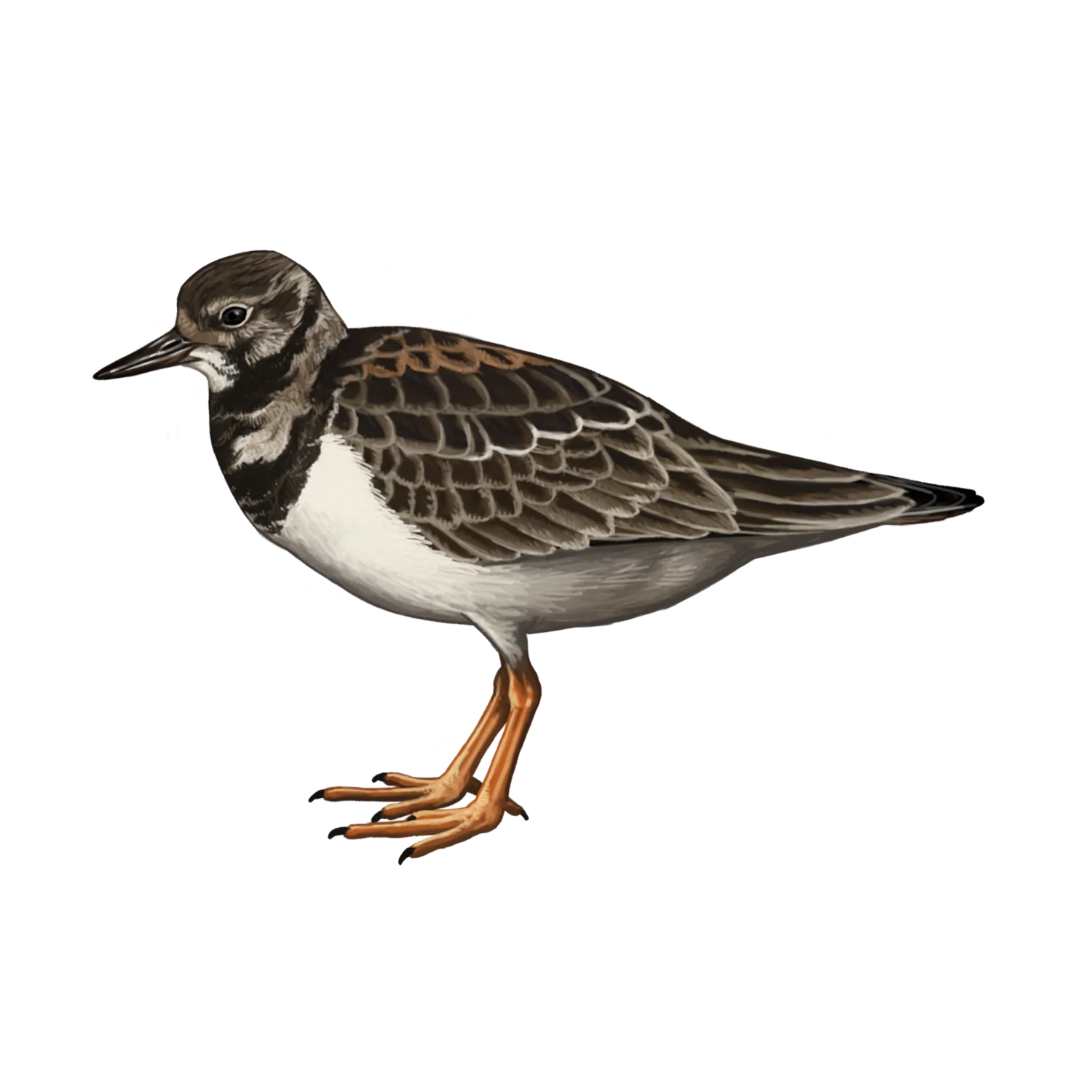
Ruddy Turnstone
Scientific name: Arenaria interpres
Family scolopacidae
Phenology
- Mainland
- Wintering and passage migrant
- Madeira
- Wintering and passage migrant
- Azores
- Wintering and passage migrant
Conservation status
Learn more- Mainland
- Madeira
- Azores
- IUCN Global
Data
Maps
Arenaria | Winter
Scale
Minimum value:
Maximum value:
Scale
Minimum value:
Maximum value:
Scale
Minimum value:
Maximum value:
Scale
Minimum value:>
Maximum value:<
Scale
Minimum value:
Maximum value:
Scale
Minimum value:>
Maximum value:>
Distribution based on seabird tracking data (locations/hexagone).
Colony(ies) of origin:
Device:
Data period / number of individuals:
Data period / number of individuals:
Distribution of seabird breeding colonies or sites (number of breeding pairs).
Distribution based on marine censuses (probability of occurrence).
Observed density based on marine censuses (birds/ km2).
Confirmed occurence during marines censuses.
Abundance of waders derived from Project Arenaria coastal surveys (birds/square).
Passage rates derived from RAM coastal surveys (birds/hour).
No data available for the selected period.
Presentation
Distribution, movements and phenology
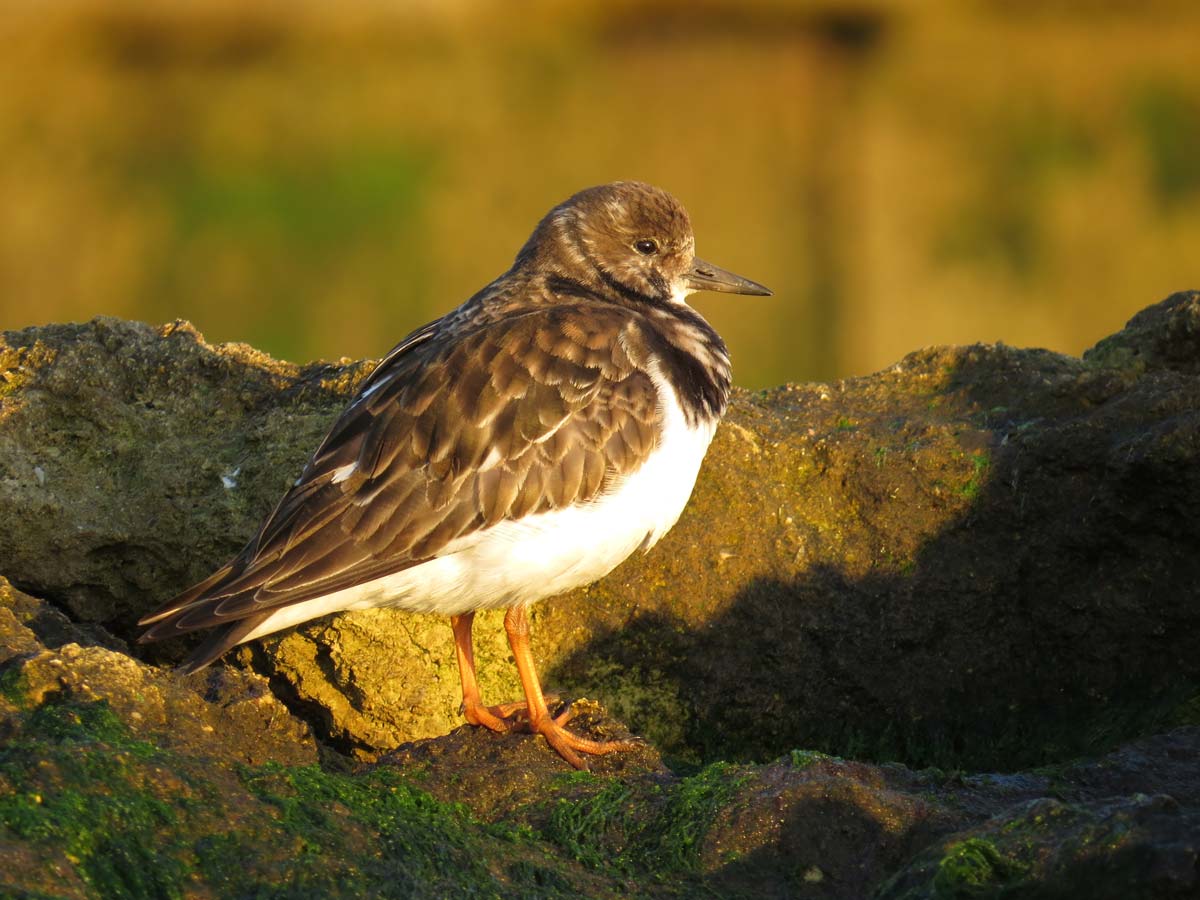
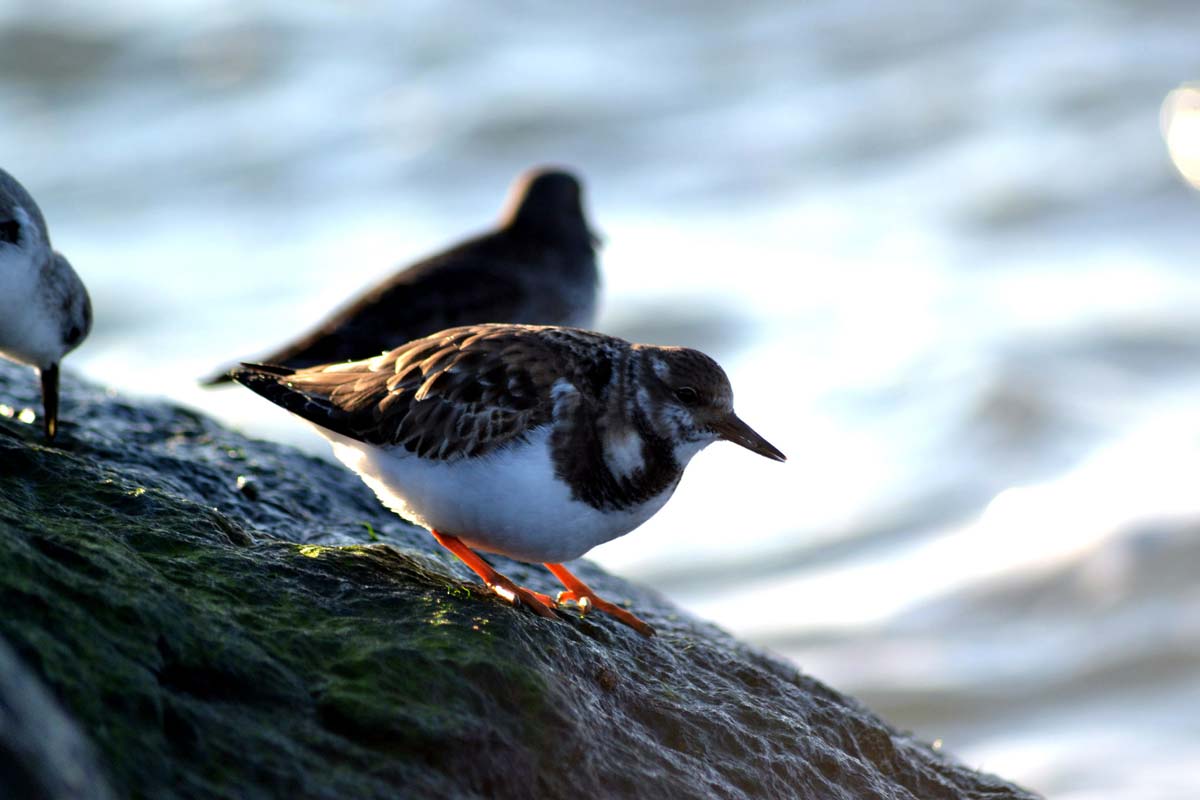
The Ruddy Turnstone breeds between May and August in the Arctic and sub-Arctic regions. Its wintering grounds along the eastern Atlantic stretch from Northern Europe to South Africa (Delany et al. 2009). In Portugal, migratory and wintering birds are found, originating from Northern Europe, Siberia, Greenland and the Canadian Arctic. Although they can be observed throughout the year, they become more abundant in August due to the passage of birds heading towards Africa, with part of the population remaining in Portugal throughout the winter. In April and May, numbers rise again due to migrants that have wintered further south (Catry et al. 2010a). The birds that remain throughout the year are immature or non-breeding individuals. The Ruddy Turnstone can be found along the entire coastline of Mainland Portugal, including estuaries, lagoon areas and beaches. On the latter, the species is absent only from stretches of extensive sandy beaches devoid of rocky intertidal zones, such as the long sandy shores of the districts of Coimbra and Leiria. It very rarely strays from the coastline. The archipelagos of the Azores and Madeira, including the Selvagens Islands, are also part of its migratory routes and wintering grounds, and it can be found on all the islands and many of the islets (Equipa Atlas 2018).
Abundance and population trends
The global population has been estimated at between two and three million mature individuals, with a declining trend (BirdLife International 2025). The wintering population in Europe may have contributed to the decline in recent decades (Delany et al. 2009), but the causes are unknown. In Portugal, the wintering population in coastal estuaries and lagoons has been around a thousand individuals (Catry et al. 2010a) and approximately 2,300 individuals on the Mainland coast (Lecoq et al. 2013). In the archipelagos of the Azores and Madeira, it winters in considerable numbers (Equipa Atlas 2018), although no robust estimates are available. The Mainland and Azores populations have not achieved Good Environmental Status for the abundance indicator, unlike the Madeira population.
Ecology and habitat
The Ruddy Turnstone is closely associated with rocky coastal habitats, as well as similar artificial structures. It prefers areas with a wide intertidal zone where disturbance from people, dogs and birds of prey is minimal (Lourenço et al. 2013). In estuarine and lagoon areas, it is also associated with coarse sediments and rocky areas. Occasionally, the species is observed in rice paddies, which are also coastal. It feeds mainly on small invertebrates (Billerman et al. 2026). Information on its diet in Portugal is very scarce, although there is evidence that it feeds on gastropods (Lourenço 2019).
Threats and conservation
Several threats to the species have been identified globally; however, the extent of their effects is unknown (BirdLife International 2025). Habitat degradation and conversion appear to be two of the main threats in the areas used during migration and wintering. In Portugal, the main threats are associated with disturbance at feeding and resting sites.
- Autor
Nuno Oliveira
Lourenço PM, Catry P, Lecoq M, Ramírez I & Granadeiro JP (2013). Role of disturbance, geology and other environmental factors in determining abundance and diversity in coastal avian communities during winter. Marine Ecology Progress Series 479: 223-234. Bibliography:
Lourenço PM (2019). Internet photography forums as sources of avian dietary data: bird diets in Continental Portugal. Airo 26:3-26. Bibliography:
Lecoq M, Lourenço PM, Catry P, Andrade J & Granadeiro JP (2013). Wintering waders on the Portuguese mainland non-estuarine coast: results of the 2009-2011 survey. Wader Study Group Bulletin 120: 66-70. Bibliography:
Equipa Atlas (2018). Atlas das Aves Invernantes e Migradoras de Portugal 2011-2013. Sociedade Portuguesa para o Estudo das Aves, LabOr- Laboratório de Ornitologia – ICAAM - Universidade de Évora, Instituto da Conservação da Natureza e das Florestas, Instituto das Florestas e Conservação da Natureza (Madeira), Secretaria Regional da Energia, Ambiente e Turismo (Açores) e Associação Portuguesa de Anilhadores de Aves. Lisboa. Bibliography:
Delany S, Dodman T, Stroud D & Scott D (2009). An atlas of wader population in Africa and western Eurasia. Wetlands International, Wageningen. Bibliography:
BirdLife International (2025). IUCN Red List for birds. Downloaded from https://datazone.birdlife.org on 30.11.2025. Bibliography:
Billerman SM, Keeney BL, Kirwan GM, Medrano F, Sly ND & Smith MG (eds.) (2026). Birds of the World. Cornell Laboratory of Ornithology, Ithaca, NY, USA. Bibliography:
Catry P, Costa H, Elias G & Matias R (2010a). Aves de Portugal, Ornitologia do Território Continental. Assírio e Alvim, Lisboa Glossary:
Individuals capable of breeding, used as a reference in population estimates. Glossary:
A group of molluscs that includes snails and whelks, common in coastal habitats and frequently consumed by waders. Glossary:
The coastal area that is exposed at low tide and submerged at high tide. Glossary:
Areas where birds remain outside the breeding season, generally associated with favourable conditions for feeding and survival. Glossary:
A species or parameter that reflects the state of an ecosystem or environmental changes. Glossary:
The direction of change in the size of a population over time (increase, decline or stability). Glossary:
A concept defined under the Marine Strategy Framework Directive (MSFD), referring to the condition of the elements of the marine environment, including birds. It aims to assess whether ecosystems are healthy, balanced and capable of supporting ecological functions and human uses in a sustainable manner. The ultimate goal is for the components and ecosystems to achieve Good Environmental Status. Glossary:
A period generally corresponding to the winter months, which may include part of autumn.