
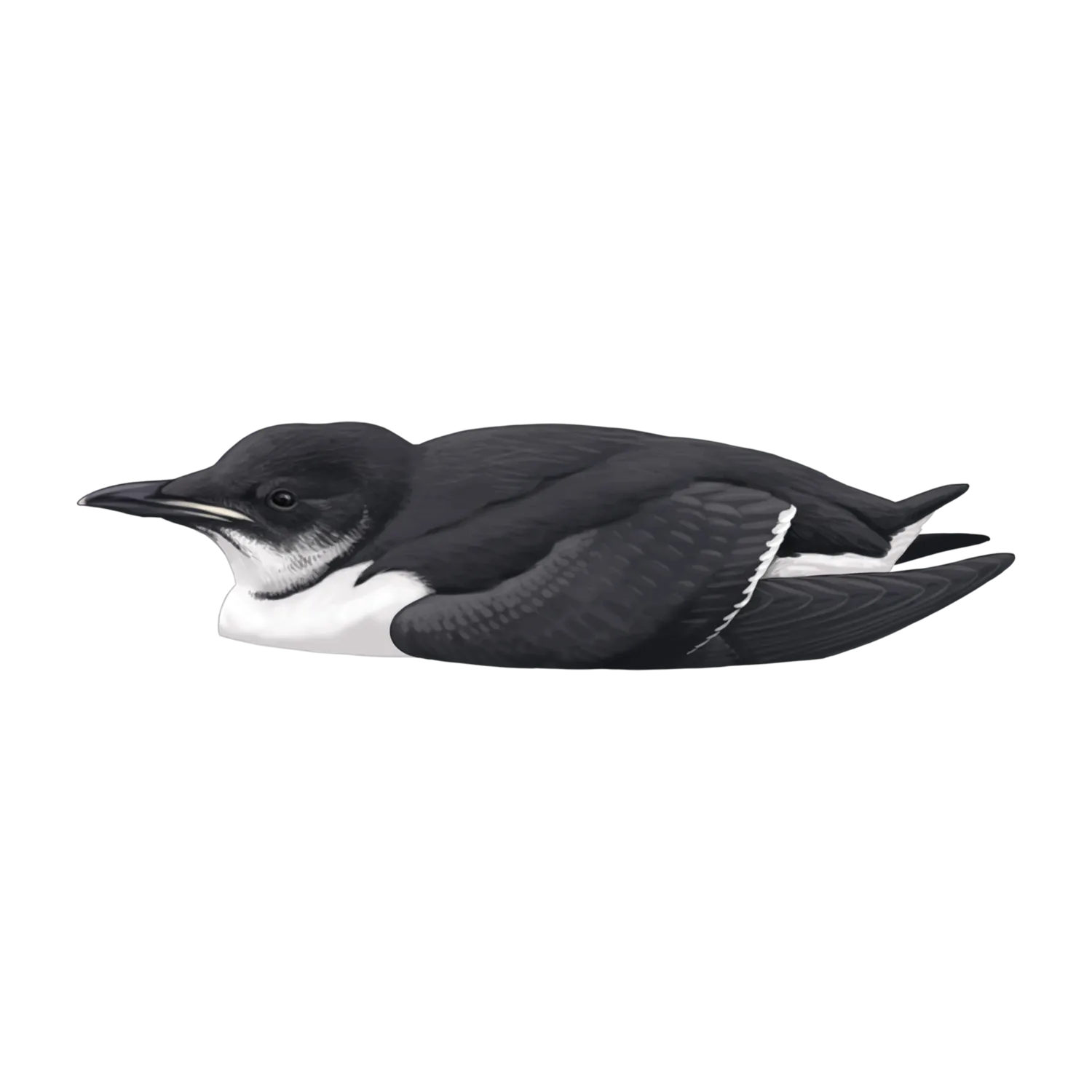
Thick-billed Murre
Scientific name: Uria lomvia
Family alcidae
Phenology
- Mainland
- Vagrant
- Madeira
- Vagrant
- Azores
- Vagrant
Conservation status
Learn more- Mainland
- Madeira
- Azores
- IUCN Global
Maps
Distribution | Non-breeding
Scale
Minimum value:
Maximum value:
Scale
Minimum value:
Maximum value:
Scale
Minimum value:
Maximum value:
Scale
Minimum value:>
Maximum value:<
Scale
Minimum value:
Maximum value:
Scale
Minimum value:>
Maximum value:>
Distribution based on seabird tracking data (locations/hexagone).
Colony(ies) of origin:
Device:
Data period / number of individuals:
Data period / number of individuals:
Distribution of seabird breeding colonies or sites (number of breeding pairs).
Distribution based on marine censuses (probability of occurrence).
Observed density based on marine censuses (birds/ km2).
Confirmed occurence during marines censuses.
Abundance of waders derived from Project Arenaria coastal surveys (birds/square).
Passage rates derived from RAM coastal surveys (birds/hour).
No data available for the selected period.
Presentation
Distribution, movements and phenology
The Thick-billed Murre breeds in coastal areas and on islands scattered throughout the Arctic (Billerman et al. 2026), remaining in these areas throughout the breeding season, between May and August. After this period, birds from some populations migrate to more southerly regions, utilising, for example, the waters of the North Atlantic, and may reach more temperate zones (Frederiksen et al. 2016). Based on data from six birds fitted with GLS between 2008 and 2012 and originating from colonies in Canada, Greenland and Iceland, the use of the Portuguese EEZ during the non-breeding period was observed. Records occurred in areas furthest from the coast, with particular emphasis on the Azores sub-area.
Abundance and population trends
The global population has been estimated at over 22,000,000 individuals, of which 1,920,000 to 2,840,000 mature individuals breed in Europe. Although the lack of up-to-date estimates, the population is believed to be increasing (BirdLife International 2025). In Portugal, this species is very rare, and there are no estimates of its abundance or population trend. There are only two records in the Azores accepted by the Portuguese Rarities Committee (Tipper et al. 2022).
Ecology and habitat
The Thick-billed Murre is a strictly marine species that feeds on fish, squid and crustaceans. It feeds both near the seabed, at relatively shallow depths, and in the water column (Billerman et al. 2026).
Threats and conservation
The species’ large global population suggests that, for the time being, there are no significant conservation concerns. However, some threats have been identified, namely egg harvesting, hunting of adult birds, disturbance of breeding colonies, pollution by oil and other toxic chemicals, bycatch in fishing gear and the degradation of its habitats (Billerman et al. 2026). It is also vulnerable to climate change, such as rising sea temperatures, which alter the availability of prey (Irons et al. 2008).
- Autor
Nuno Oliveira
- Owners/sources of tracking data
Frederiksen 2013, Linnebjerg & Frederiksen 2011, Merkel 2012, Thorarinsson & Kolbeinsson 2014d, Thorarinsson & Kolbeinsson 2014e, Tranquilla et al. 2008, Tranquilla et al. 2010, Tranquilla et al. 2011
Tipper R, Alfrey P, Alves P, Cardoso H, Crochet P-A, Leitão AH, Ramalho P, Robb M & Valkenburg T (2022). Aves de ocorrência rara ou acidental em Portugal. Relatório do Comité Português de Raridades referentes ao ano de 2020. Anuário Ornitológico 14: 3-51. Bibliography:
Irons DB, Anker-Nilssen T, Gaston AJ, Byrd GV, Falk K, Gilchrist HG, Hario M, Hjernquist M, Krasnov YV, Mosbech A, Olsen B, Petersen A, Reid JB, Robertson GJ, Strom H & Wohl KD (2008). Fluctuations in circumpolar seabird populations linked to climate oscillations. Global Change Biology 14: 1455-1463. Bibliography:
Frederiksen M, Descamps S, Erikstad KE, Gaston AJ, Gilchrist HG, Grémillet D, Johansen KL, Kolbeinsson Y, Linnebjerg JF, Mallory ML, McFarlane Tranquilla LA, Merkel FR, Montevecchi WA, Mosbech A, Reiertsen TK, Robertson GJ, Steen H, Strøm H & Thórarinsson TL (2016). Migration and wintering of a declining seabird, the thick-billed murre Uria lomvia, on an ocean basin scale: Conservation implications. Biological Conservation 200: 26-35. Bibliography:
BirdLife International (2025). IUCN Red List for birds. Downloaded from https://datazone.birdlife.org on 30.11.2025. Bibliography:
Billerman SM, Keeney BL, Kirwan GM, Medrano F, Sly ND & Smith MG (eds.) (2026). Birds of the World. Cornell Laboratory of Ornithology, Ithaca, NY, USA. Data:
Tranquilla LM, Montevecchi W, Gilchrist HG & Mallory M (2011). Dataset 1113: Thick-billed Murre, Uria lomvia, Geolocator (GLS), Gannet Islands, Gannet Islands, Canada, 2008–2011. BirdLife International Seabird Tracking Database. Downloaded from https://data.seabirdtracking.org/dataset/1113/ on 30.11.2025. Data:
Tranquilla LM, Montevecchi W, Gilchrist HG & Mallory M (2008). Dataset 1114: Thick-billed Murre, Uria lomvia, Geolocator (GLS), Minarets, Minarets, Canada, 2007–2008. BirdLife International Seabird Tracking Database. Downloaded from https://data.seabirdtracking.org/dataset/1114/ on 30.11.2025. Data:
Tranquilla LM, Mallory M, Montevecchi W & Gilchrist HG (2010). Dataset 1109: Thick-billed Murre, Uria lomvia, Geolocator (GLS), Prince Leopold Island, Arctic Canada, Canada, 2009–2010. BirdLife International Seabird Tracking Database. Downloaded from https://data.seabirdtracking.org/dataset/1109/ on 30.11.2025. Data:
Thorarinsson TL & Kolbeinsson Y (2014e). Dataset 1079: Thick-billed Murre, Uria lomvia, Geolocator (GLS), Grimsey, Iceland, Iceland, 2013–2014. BirdLife International Seabird Tracking Database. Downloaded from https://data.seabirdtracking.org/dataset/1079/ on 30.11.2025. Data:
Thorarinsson TL & Kolbeinsson Y (2014d). Dataset 1078: Thick-billed Murre, Uria lomvia, Geolocator (GLS), Langanes, Iceland, Iceland, 2013–2014. BirdLife International Seabird Tracking Database. Downloaded from https://data.seabirdtracking.org/dataset/1078/ on 30.11.2025. Data:
Merkel F (2012). Dataset 1068: Thick-billed Murre, Uria lomvia, Geolocator (GLS), Innaq, Greenland, Greenland, 2011–2012. BirdLife International Seabird Tracking Database. Downloaded from https://data.seabirdtracking.org/dataset/1068/ on 30.11.2025. Data:
Linnebjerg JF & Frederiksen M (2011). Dataset 1066: Thick-billed Murre, Uria lomvia, Geolocator (GLS), Kitsissut Avaaliit, Greenland, Greenland, 2009–2011. BirdLife International Seabird Tracking Database. Downloaded from https://data.seabirdtracking.org/dataset/1066/ on 30.11.2025. Data:
Frederiksen M (2013). Dataset 1065: Thick-billed Murre, Uria lomvia, Geolocator (GLS), Kippaku, Greenland, Greenland, 2008–2013. BirdLife International Seabird Tracking Database. Downloaded from https://data.seabirdtracking.org/dataset/1065/ on 30.11.2025. Glossary:
Individuals capable of breeding, used as a reference in population estimates. Glossary:
A group of marine arthropods that are important in the marine food chain. Glossary:
Persistent changes in global or regional climate patterns, influenced by natural and anthropogenic factors. Glossary:
The direction of change in the size of a population over time (increase, decline or stability). Glossary:
Refers to the unintentional capture of marine species during fishing. Animals may become entangled in hooks or fishing nets. It is usually associated with commercial fishing, but can also occur in recreational fishing. Bycatch is one of the main threats to seabirds at sea. Glossary:
Under the United Nations Convention on the Law of the Sea, coastal states are entitled to declare an EEZ comprising maritime area beyond their territorial waters. The national EEZ is delimited by an imaginary line situated 200 nautical miles from the coast, separating national waters from international or shared waters. Within its EEZ, each state has rights such as the exploitation of marine resources, the conduct of scientific research and the regulation of fishing by foreign vessels. Glossary:
A small device attached to birds to study their large-scale movements (usually migration), which works by recording light intensity (from which the duration of night and the local midday time are estimated, and consequently the latitude and longitude on each day).